Understanding the ASIA Impairment Scale in Spinal Cord Injury Rehabilitation
The ASIA Impairment Scale (AIS) is an essential classification system in spinal cord injury (SCI) rehabilitation. This guide breaks down what the AIS is, how the test is carried out and what the scores mean, and—most importantly—how to use it to guide treatment and set expectations.
What is the ASIA Impairment Scale?
The ASIA Impairment Scale is part of the International Standards for Neurological Classification of Spinal Cord Injury (ISNCSCI). It provides a standardized way to classify the severity and completeness of a spinal cord injury based on a detailed sensory and motor exam.
This exam is typically completed within 72 hours of injury, upon admission to inpatient rehabilitation, at discharge, and then at the one-year mark, however this frequency may be adjusted depending on various factors.
Key Components of the ASIA Exam
To determine AIS classification, clinicians perform a standardized exam that includes:
1. Sensory Testing
- Light touch and pinprick
- Tested across 28 dermatomes bilaterally
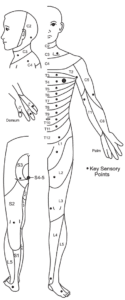
- Scored on a 0–2 scale:
- 0 = absent
- 1 = impaired
- 2 = normal
2. Motor Testing
- Strength testing of 10 key muscle groups, representing myotomes, bilaterally:
- Elbow flexors (C5)
- Wrist extensors (C6)
- Elbow extensors (C7)
- Finger flexors (C8)
- Finger abductors, little finger (T1)
- Hip flexors (L2)
- Knee extensors (L3)
- Ankle dorsiflexors (L4)
- Long toe extensors (L5)
- Ankle plantarflexors (S1)
- Scored using the standard 0–5 MMT scale
- 0= No visible/palpable contraction, total paralysis
- 1= Trace contraction, visible/palpable without motion
- 2=Full ROM with gravity eliminated
- 3= Full ROM against gravity
- 4= Full ROM against gravity with some resistance
- 5= Full ROM against gravity with full resistance
3. Sacral Sparing
Sacral sparing refers to the preservation of any sensory or motor function in the lowest sacral segments of the spinal cord (S4–S5) following SCI.
These segments correspond to:
- The perianal region
- The external anal sphincter
Even minimal function here changes the entire classification of the injury because the presence of sacral sparing automatically designates an injury as incomplete. If sacral sparing is absent, the injury is classified as complete (AIS A).
How Sacral Sparing is Assessed
There are three key components, and documenting any one of them counts as sacral sparing:
1. Light Touch or Pinprick at S4–S5
- Tested in the perianal area
- Scored the same way as other dermatomes (0–2)
Clinical note:
This can sometimes be present even when sensation is absent in more proximal dermatomes.
2. Deep Anal Pressure (DAP)
- Assessed via digital rectal exam
- Patient is asked if they can feel pressure
Key point:
DAP is often preserved even when light touch/pinprick are absent, making it especially important in borderline cases.
3. Voluntary Anal Contraction (VAC)
- Patient is asked to “squeeze as if trying to hold in a bowel movement”
- Clinician palpates for contraction of the external anal sphincter
This is the only motor component of sacral sparing.
ASIA Impairment Scale/AIS Grade
Based on the exam detailed above, a patient will be given a grade A-E, as detailed below:
- AIS A – Complete
- No sensory or motor function preserved in the sacral segments (S4–S5)
- AIS B – Sensory Incomplete
- Sensory function preserved below the neurological level and includes S4–S5
- No motor function preserved more than three levels below the motor level on either side of the body
- AIS C – Motor Incomplete
- Motor function preserved below the neurological level
- Less than half of the key muscles below the level have a MMT of 3/5 or greater
- AIS D – Motor Incomplete
- Motor function preserved below the neurological level
- At least half of the key muscles below the level have a MMT greater than or equal to 3/5
- AIS E – Normal
- Sensory and motor function are normal
Determining the Neurological Level of Injury (NLI)
The NLI is defined as the lowest level where both sensory and motor function are intact.
This is not always the same as:
- The vertebral level of injury
- Imaging findings
Understanding this distinction is essential when communicating prognosis and planning treatment.
What is a Zone of Partial Preservation (ZPP)?
The Zone of Partial Preservation (ZPP) is a classification which was historically used only in complete spinal cord injuries (AIS A) to describe how far below the neurological level some function still exists.
In other words, even when an injury is classified as “complete,” there may still be some preserved sensory or motor function below the level of injury—just not all the way to the sacral segments (S4–S5).
However, newer guidance allows ZPP to be applied in select incomplete injuries under specific conditions, allowing for further description of how much function exists below the NLI without a change to the AIS classification.
ZPP identifies the lowest spinal segments with any preserved function:
- Sensory ZPP: Lowest dermatome with any sensory function
- Motor ZPP: Lowest myotome with any voluntary motor function
This should be documented separately for the right vs. left side.
Patients with more extensive ZPP:
- May have greater potential for neurological recovery
- May be more likely to convert to their AIS classification over time
This can also help guide treatment focus, as preserved motor zones may be targets for NMES/FES to drive muscle re-education and strengthening. Preserved sensory zones may support improved body awareness during functional mobility.
Why the AIS Matters Clinically
1. Prognosis
It is important to remember that the AIS grade can change with time and rehabilitation, which is why reassessment of the AIS is recommended at various intervals and as presentation evolves. AIS classification is strongly associated with recovery potential:
- AIS A: Lower likelihood of significant motor recovery below the level of injury
- However, approximately 30% of patients with complete injuries will see some degree of motor or sensory recovery while in inpatient rehabilitation (Sangari 2023)
- ZPP may offer areas below the level of injury to target for improved recovery
- AIS B: Some potential for motor return; particularly within the first 6-9 months, and more common in tetraplegia than paraplegia (Kirshblum 2021)
- AIS C: Moderate potential for functional recovery
- AIS D: Highest likelihood of regaining functional ambulation
While not absolute, these trends are useful for setting expectations early on.
2. Goal Setting
When writing goals, the AIS score can help guide realistic, individualized goals:
- AIS A–B:
- Focus on increasing independence with mobility, potentially at first through compensatory strategies, and secondary prevention
- Utilize the table in this document as a reference for expected outcomes based on level of injury to help write appropriate functional goals; remember that this is just a starting point, and some patients can progress beyond these anticipated levels
- Introduce adaptive equipment and wheelchair skills
- Consider creating goals for the patient to direct their own care: instructing caregivers on how to setup the hoyer sling and lift, how to assist with rolling, how to execute their stretching program, or how to setup their home FES/NMES system
- AIS C–D:
- Emphasize motor recovery and task-specific training; be sure to focus on the principles of neuroplasticity
- Prioritize goals related to independence with functional mobility
- Consider gait training, transfers, and strengthening
3. Treatment Planning
AIS classification can influence intervention selection, below is by no means an exhaustive list of treatments, but a few to consider:
- Neuromuscular electrical stimulation (NMES/FES):
- Highly recommended for all AIS levels to reduce/reverse atrophy, decrease spasticity, and increase local blood circulation
- FES is a critical component of a well-rounded plan of care to foster neuro-muscular re-education
- Read how the internationally renowned Craig Hospital utilizes FES cycling as a central foundation to its SCI rehabilitation program
- Cardiorespiratory Conditioning
- Promoting cardiorespiratory health is of the utmost importance after SCI, as it is the leading cause of mortality in chronic injuries
- It is essential to identify forms of exercise that the patient can engage in both during rehabilitation and after discharge to promote improved cardiovascular and respiratory health
- It’s never too early to refer patients for a home FES cycle so they can seamlessly transition to maintaining their health once discharged
- Starting earlier may be helpful in lengthy insurance reimbursement cases or when applying for grant funding
- Caregiver training
- Invite caregivers to participate in sessions throughout the plan of care, rather than relying on a single session to cover all training
- More sessions will likely be needed in patients with more limited mobility
- Gait training:
- Patients with AIS C–D are typically the best candidates, depending on strength and control
- For individuals with AIS A or B and sufficient upper body and core strength, KAFO training may be appropriate
How to Use AIS in Everyday Practice
Instead of viewing AIS as a one-time classification, think of it as a clinical anchor point:
- Use it to guide initial prognosis conversations
- Reassess periodically to track neurological recovery
- Pair it with functional outcome measures (e.g., 10MWT, 6 Minute Push Test) to quantify progress
- Use it to justify interventions
Limitations of the ASIA Impairment Scale
While AIS is widely used in SCI rehabilitation, it has important limitations to consider in clinical practice.
1. It Measures Impairment—Not Function
AIS reflects neurological impairment, not overall function. Individuals with the same AIS grade can have very different levels of independence and abilities.
2. It Does Not Capture the Full Clinical Picture
The ASIA exam focuses on sensory and motor function, but does not account for factors like pain, spasticity, or dysesthesias, all of which can significantly impact outcomes.
3. It Depends on the Exam
Classification is based on a bedside assessment and can be influenced by patient presentation and examiner experience. Subtle findings, particularly sacral sparing, can affect grading if not assessed carefully.
4. It Simplifies a Complex Injury
AIS groups injuries into broad categories, which may not fully reflect differences in preserved function between individuals. Additional details, like the ZPP, help provide a more complete picture.
5. It Represents a Point in Time
AIS reflects a single moment in recovery and can change, especially early after injury. Some individuals initially classified as complete may later demonstrate features of incomplete injury.
AIS is a valuable framework for classifying spinal cord injury, but it should not be used in isolation.
It is best understood as:
- A standardized snapshot of neurological impairment
- One piece of a larger clinical picture that includes function, symptoms, and individual variability
Putting It All Together
The ASIA Impairment Scale gives clinicians a shared language to describe SCI severity. But its real value comes from how it informs decision-making:
- What recovery is possible
- Where to focus treatment
- How to set meaningful, achievable goals
Combined with functional outcome measures and clinical reasoning, AIS helps guide rehabilitation priorities and progression, but it does not define the individual or limit what may be possible over time.
References
- American Spinal Injury Association. (2019). International Standards for Neurological Classification of Spinal Cord Injury (Revised 2019). https://asia-spinalinjury.org
- Steven C. Kirshblum, Frederick Biering-Sørensen, William Waring, et al. (2019). International standards for neurological classification of spinal cord injury (Revised 2019). The Journal of Spinal Cord Medicine, 42(Suppl 1), S1–S84.
- Steven C. Kirshblum, William Waring, Frederick Biering-Sørensen, et al. (2011). International standards for neurological classification of spinal cord injury (Revised 2011). The Journal of Spinal Cord Medicine, 34(6), 535–546.
- J. J. van Middendorp, A. J. F. Hosman, M. H. Pouw, et al. (2009). Is determination between complete and incomplete traumatic spinal cord injury clinically relevant? Validation of the ASIA sacral sparing criteria in a prospective cohort of 432 patients. Spinal Cord, 47(11), 809–816.
- Yuto Ariji, Tetsuo Hayashi, Ryosuke Ideta, et al. (2022). Identification of a reliable sacral-sparing examination to assess the ASIA impairment scale in patients with traumatic spinal cord injury. The Journal of Spinal Cord Medicine.
- Consortium for Spinal Cord Medicine. (2008). Outcomes following traumatic spinal cord injury: Clinical practice guidelines for health-care professionals.
- Spinal Cord Injury Research Evidence. (2020). SCIRE Professional: Rehabilitation Evidence for Spinal Cord Injury. https://scireproject.com
- John F. Ditunno Jr., Young-Jae Kim, William Donovan, et al. (2000). Walking index for spinal cord injury (WISCI II): Scale revision. Spinal Cord, 38, 234–243.
- Richard P. Burns, John F. Ditunno Jr.. (2001). Diagnosis and prognosis of traumatic spinal cord injury. Handbook of Clinical Neurology, 109, 47–62.
- Gail S. Flett, & David X. Cifu (Eds.). (2014). Spinal Cord Injury Rehabilitation (2nd ed.). Elsevier.
- Sangari, Sina et al. “Spasticity Predicts Motor Recovery for Patients with Subacute Motor Complete Spinal Cord Injury.” Annals of neurology, 10.1002/ana.26772. 22 Aug. 2023, doi:10.1002/ana.26772
- Schuld, C., EMSCI study group., Kirshblum, S. et al. The revised zone of partial preservation (ZPP) in the 2019 International Standards for Neurological Classification of Spinal Cord Injury: ZPP applicability in incomplete injuries. Spinal Cord 62, 79–87 (2024). https://doi.org/10.1038/s41393-023-00950-x
- Kirshblum, S. C., et al. (2019). International standards for neurological classification of spinal cord injury (Revised 2019). The Journal of Spinal Cord Medicine.
- Roberts, T. T., Leonard, G. R., & Cepela, D. J. (2017). Classifications in brief: American Spinal Injury Association (ASIA) Impairment Scale. Clinical Orthopaedics and Related Research.
- Ariji, Y., et al. (2024). Identification of a reliable sacral-sparing examination to assess the ASIA impairment scale in patients with traumatic spinal cord injury. The Journal of Spinal Cord Medicine.
- Steven C. Kirshblum, et al. (2021). The role of sacral sparing in determining completeness and predicting recovery after spinal cord injury. Archives of Physical Medicine and Rehabilitation. https://pmc.ncbi.nlm.nih.gov/articles/PMC8080912/