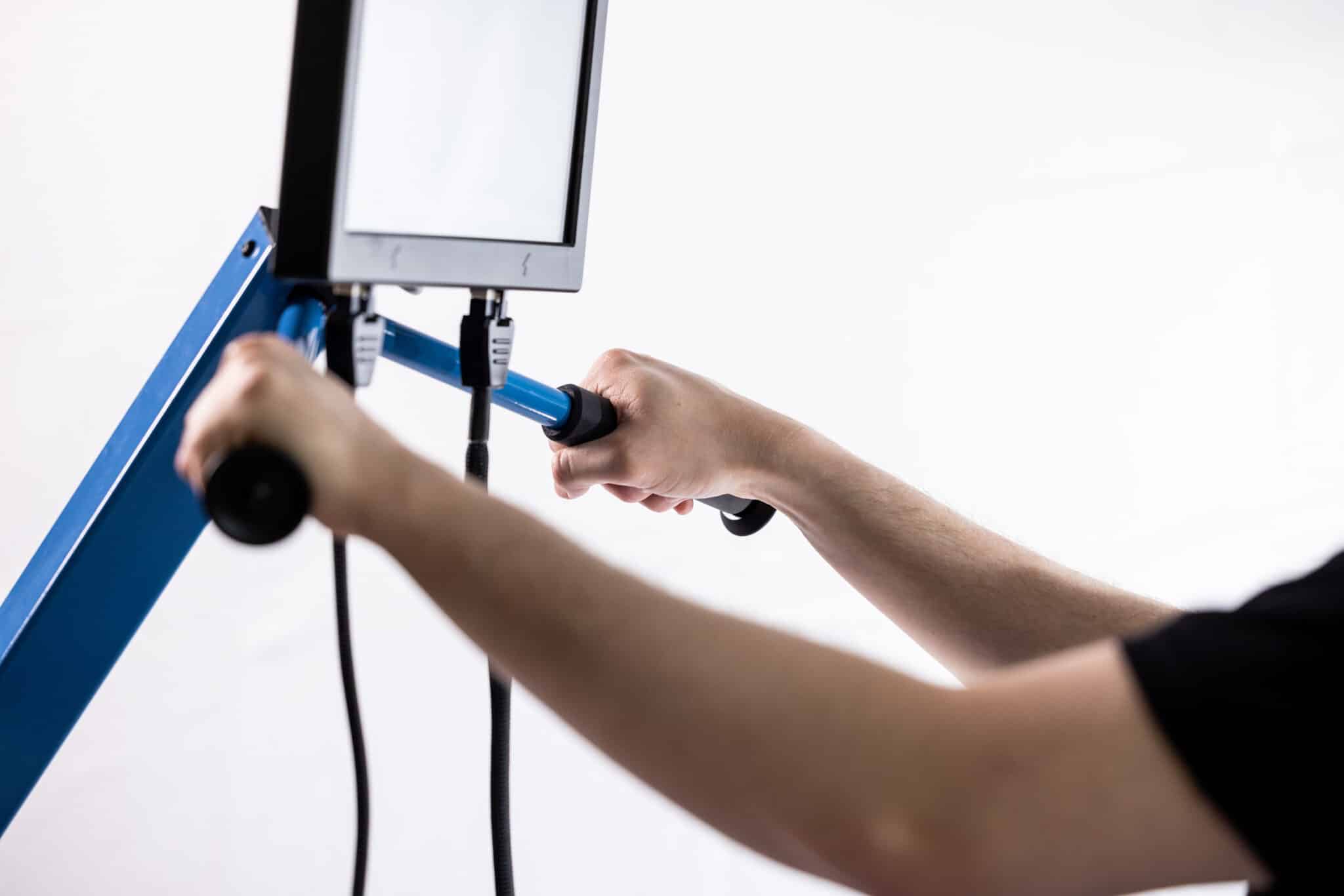
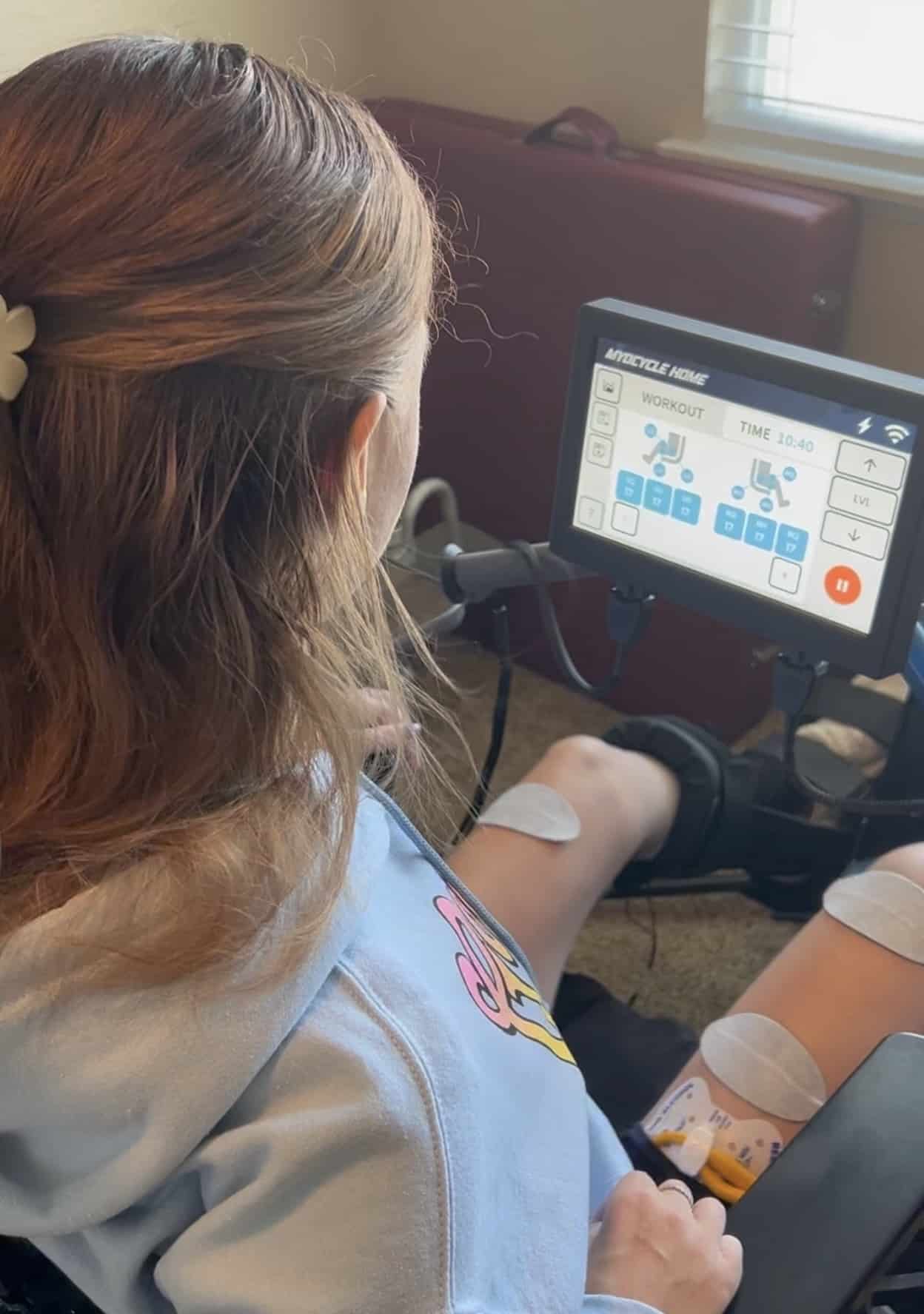
Two emerging technologies have the potential to revolutionize mobility for people with paralysis. Namely, robotic exoskeletons and functional electrical stimulation (FES). Exoskeletons are wearable robots designed to help people move better. FES uses small electrical pulses to externally activate muscles, helping someone move their own limbs with their own muscles, even despite paralysis. Each technology has its own unique benefits and challenges – would a combined system be lesser or greater than the sum of its parts?
Benefits of Exoskeletons
- Exoskeletons can help people walk after a neurological injury, and walking is important for both functional mobility and activity-based therapy.
- Standing and moving at eye level in an exoskeleton can be an empowering experience for someone who normally uses a wheelchair.

Challenges with Exoskeletons
- Exoskeletons require powerful and efficient motors to be effective, but these are often large, heavy, and expensive. Exoskeletons need to be slim, lightweight, and affordable, so they need to use slim, lightweight, and affordable motors.
- Exoskeleton users need strong bones to endure bodyweight support, but people with paralysis generally have weakened bones, disqualifying them from even trying an exoskeleton.
Benefits of Functional Electrical Stimulation
- FES devices can help people with paralysis use their own muscles to perform functional activities.
- Exercise with FES can provide the same benefits of voluntary exercise to people who otherwise cannot exercise because of paralysis, including stronger bones.
- FES devices can easily be made slim, lightweight, and affordable.

Challenges with Functional Electrical Stimulation
- Muscles fatigue rapidly during FES, limiting how long someone can perform functional activities.
- FES cannot selectively target muscle groups for activation (unless implanted), making it difficult to control precise movements with FES.
- FES usually requires placing and connecting many electrodes and manually tuning stimulation settings for someone, which can take a long time.
Benefits of Exoskeletons + Functional Electrical Stimulation
- If a paralyzed user’s muscles can assist with FES during exoskeleton activities, then exoskeletons with FES could use smaller, lighter, and less expensive motors.
- FES could be used to power movements that are difficult for exoskeletons to perform, like plantarflexion (toe-off) during walking or knee extension during stair climbing.
- Users of exoskeletons with FES will be doing more work in any activity, increasing the therapeutic benefits of using the system.
- An exoskeleton with FES could be used for a wide range of exercises to strengthen the user’s body in preparation for and in addition to walking.
Challenges of Exoskeletons + Functional Electrical Stimulation
- Exoskeletons and FES devices are generally expensive, and a combined system could be even more expensive.
- Exoskeletons and FES can both be difficult to put on and take off, and a combined system might be too difficult to use.
- Users may need to undergo months of FES training to build their muscles up enough to contribute significantly to any exoskeleton activities.
The Verdict
- Clearly, combining exoskeletons with FES could produce systems with benefits greater than the sum of its parts.
- However, care must be taken to ensure the combined system is affordable and easy-to-use, and users may need extra training before the benefits begin to compound.
- Despite the challenges, many exoskeleton developers are integrating FES into their devices:
- Parker Hannifin has been adding FES to the Indego exoskeleton with help from Vanderbilt.Ekso Bionics partnered with Hasomed GmbH to integrate the RehaStim2 FES unit with the Ekso device.
- Researchers around the world are developing “hybrid neuroprostheses”, which are integrated exoskeleton and FES systems.
Key Takeaways
- Exoskeletons and FES both have unique potential to revolutionize mobility for people with paralysis.
- Synergies between exoskeletons and FES make an integrated system greater than the sum of its parts.
- There are challenges to integrating exoskeletons with FES, but a lot of smart people are working out the bugs, and eventually FES may become a standard feature of exoskeletons for people with paralysis.
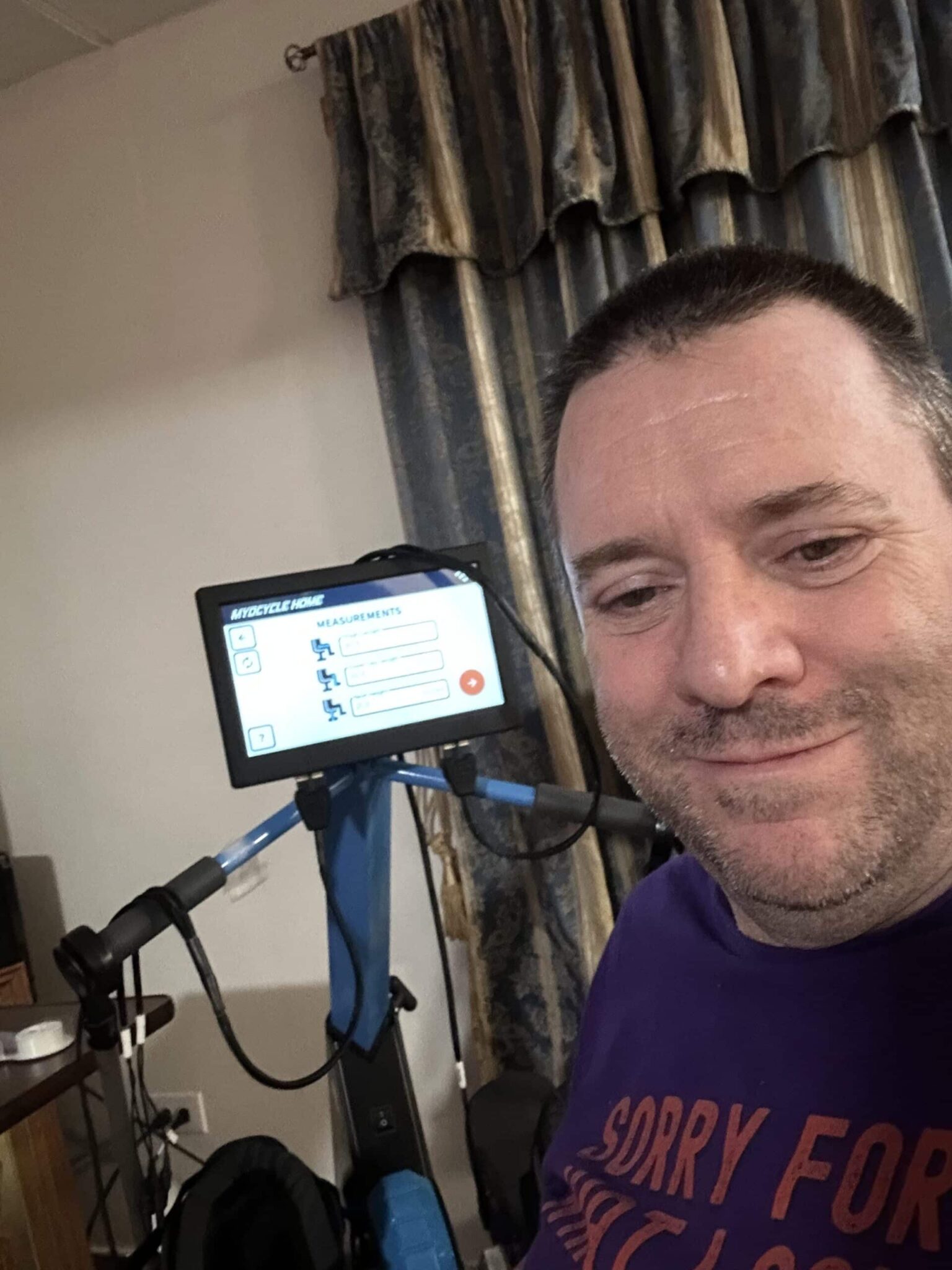
Exercise with the MyoCycle and the ReWalk Exoskeleton
To learn more about FES, click here: What is FES? To see a medical device that uses FES to help people with paralysis perform a therapeutic exercise, check out the MyoCycle! Our friends at ReWalk also have an exoskeleton that can work well in conjunction with the MyoCycle.