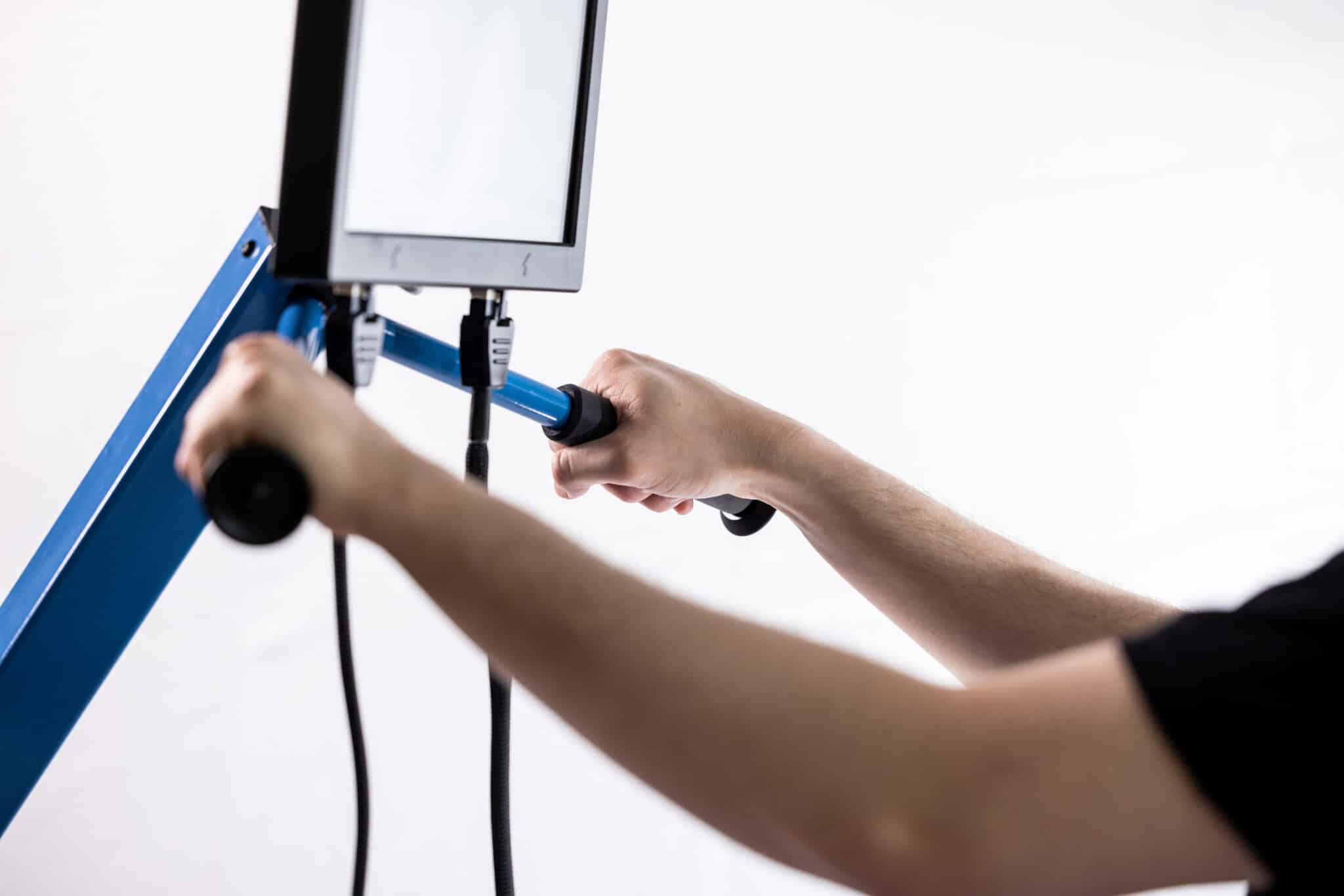
Power output on an FES bike is the number in Watts (W) on the MyoCycle console that shows how much work a rider is doing during a session. It is one of the numbers riders and therapists track from one session to the next, and it is easy to misread. This post explains where it comes from and what the research says about it.
How does an FES bike move the pedals?
The MyoCycle has an electric motor that holds the cranks at a steady 35 rpm, which is called isokinetic cycling. If a rider can’t pedal that fast, the motor pedals for them up to 35 rpm. If a rider pushes faster, the motor resists, pushing back as hard as the rider pushes while keeping the cadence smooth. Stimulation runs alongside the motor, helping the muscles to contract in time with the pedal position.
What is active power on an FES bike?
At the start of each session, the MyoCycle measures the work of moving the rider’s legs and the cranks and subtracts it from the measured power (energy per second, W). What is left is active power, the rider’s own effort, and the real-time power plot can show it down to 1 W. A rider who produces 3 W is doing 3 W of work, with the weight of the legs and the drivetrain taken out of the number.
What is the stimulation level on a stim bike?
The stimulation level on the MyoCycle console sets how strongly the muscles are stimulated, and the stimulation is timed to the pedal position so each muscle group fires at the right time as the pedals turn. Turning the level up increases the intensity of the electrical pulses sent to each muscle by raising their amplitude and lengthening their duration. Stronger pulses reach more of the muscle, so the contraction gets stronger, and the right level is the one that gives a strong, comfortable contraction for that rider.
What else is on the console?
During a session the console shows the stimulation level, elapsed time, Calories, power in Watts, and distance, with a button for each muscle group being stimulated. Every MyoCycle also shows a real-time power plot and symmetry measurements. Symmetry shows how the work is shared between the left and right legs, with an even split reading 50/50. A rider whose symmetry drifts to 90/10 is getting most of the work from one side, which is worth a conversation about electrode placement, positioning, and fatigue. Home riders also receive a progress report by email every week that summarizes all this information.
What moves the number?
Stimulation level, electrode placement, seating position, muscle health, fatigue, and many other factors change power output from one session to the next, so it helps to look at the average across several sessions, because one low session may be an outlier. Riders who are unsure why a number changed can bring it to a check-in with our clinical specialist, a licensed physical therapist, or to the monthly group ride.
What does the research say about power over time?
A 2026 retrospective analysis of the cardiovascular effects of FES cycling reviewed records of 32 people with spinal cord injury, 20 with incomplete injuries and 12 with complete injuries, each with at least ten 30-minute sessions (Mravcsik et al., Journal of Clinical Medicine). In the incomplete group, average and peak power rose significantly between the first and tenth session. In the complete group, power stayed flat over the same ten sessions.
Two practical points follow for therapists and riders:
- Power output can show change early in incomplete injuries, so it is worth recording every session
- In the complete-injury group, power stayed flat across ten sessions, so a flat curve early on is a result to expect and to talk through with the patient at the start of the program
Power is also one measure among several. The MyoCycle is intended for general rehabilitation for relaxation of muscle spasms, prevention or retardation of disuse atrophy, increasing local blood circulation, maintaining or increasing range of motion, and muscle re-education. Each of these also affects power output. With the stimulation settings held constant, bigger muscles, better blood flow, free range of motion, no spasticity, and good coordination all improve power output.
How can a therapist use power output in the plan of care?
Record the average power for each session in the daily note, along with the muscle groups stimulated, the stimulation levels, and the patient’s response. Those notes show change over time to the physician, and they are the session notes our funding team asks for when a patient is applying for coverage. Our guide to documenting FES sessions has the full list.
Riders with a question about a number on the console can call customer support at (352) 306-8431 ext. 2, and our team will connect you with our clinical specialist. If you’re considering a MyoCycle, request more information. Let us help!
The MyoCycle is a prescription-only medical device.