An FES bike is a stationary cycle that uses functional electrical stimulation (FES) to make the leg muscles contract in time with the pedals, so people with paralysis or weakness in their legs can do cycling exercise. Electrodes on the skin deliver the stimulation, and a motor helps turn the cranks. The MyoCycle is an FES bike designed and manufactured by MYOLYN in Gainesville, Florida. It is a prescription-only medical device, cleared by the FDA under 510(k) K213925. This page covers how an FES bike works, who rides one, who should not, and how people get one. To talk with our team, request more information.
What is an FES bike?
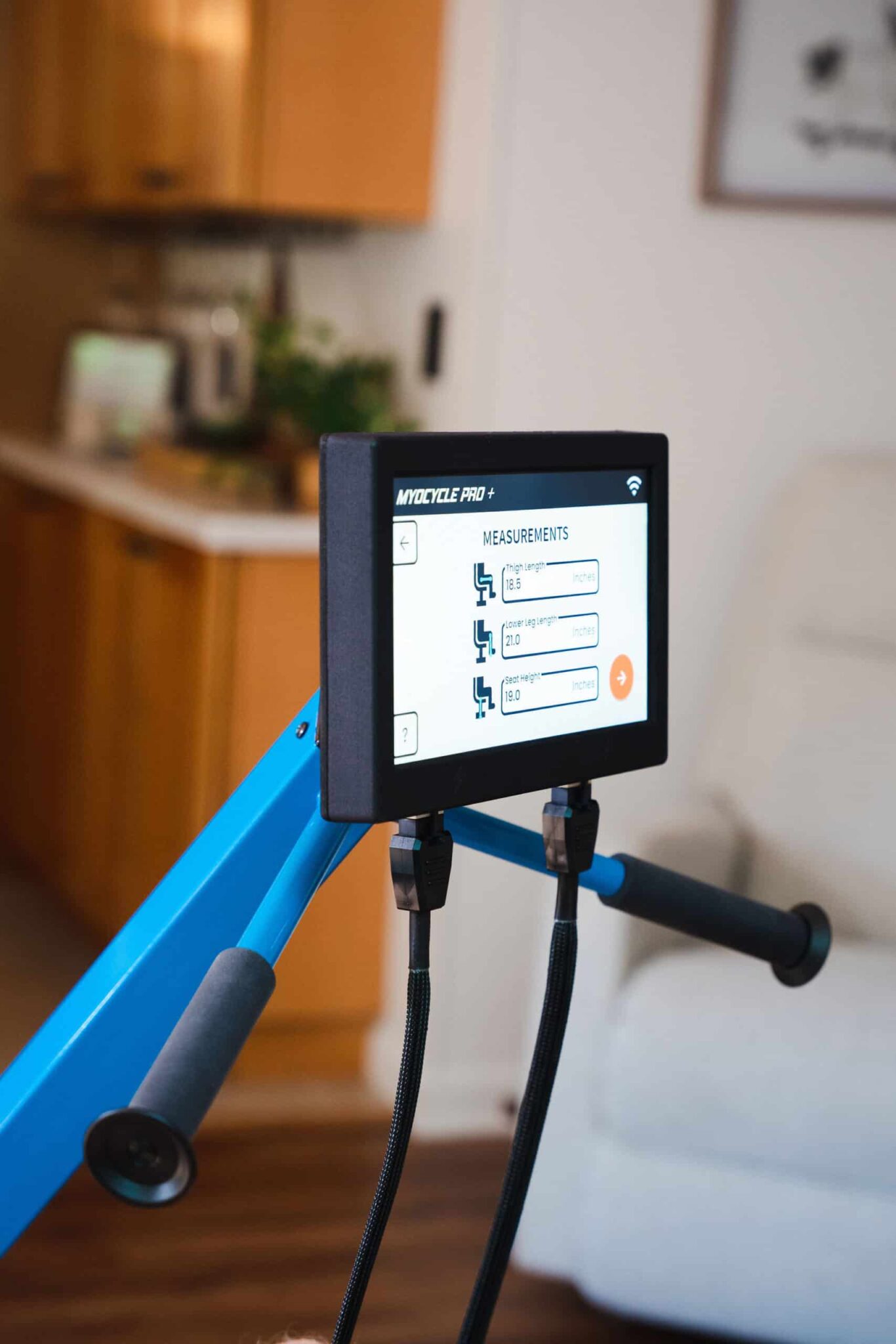
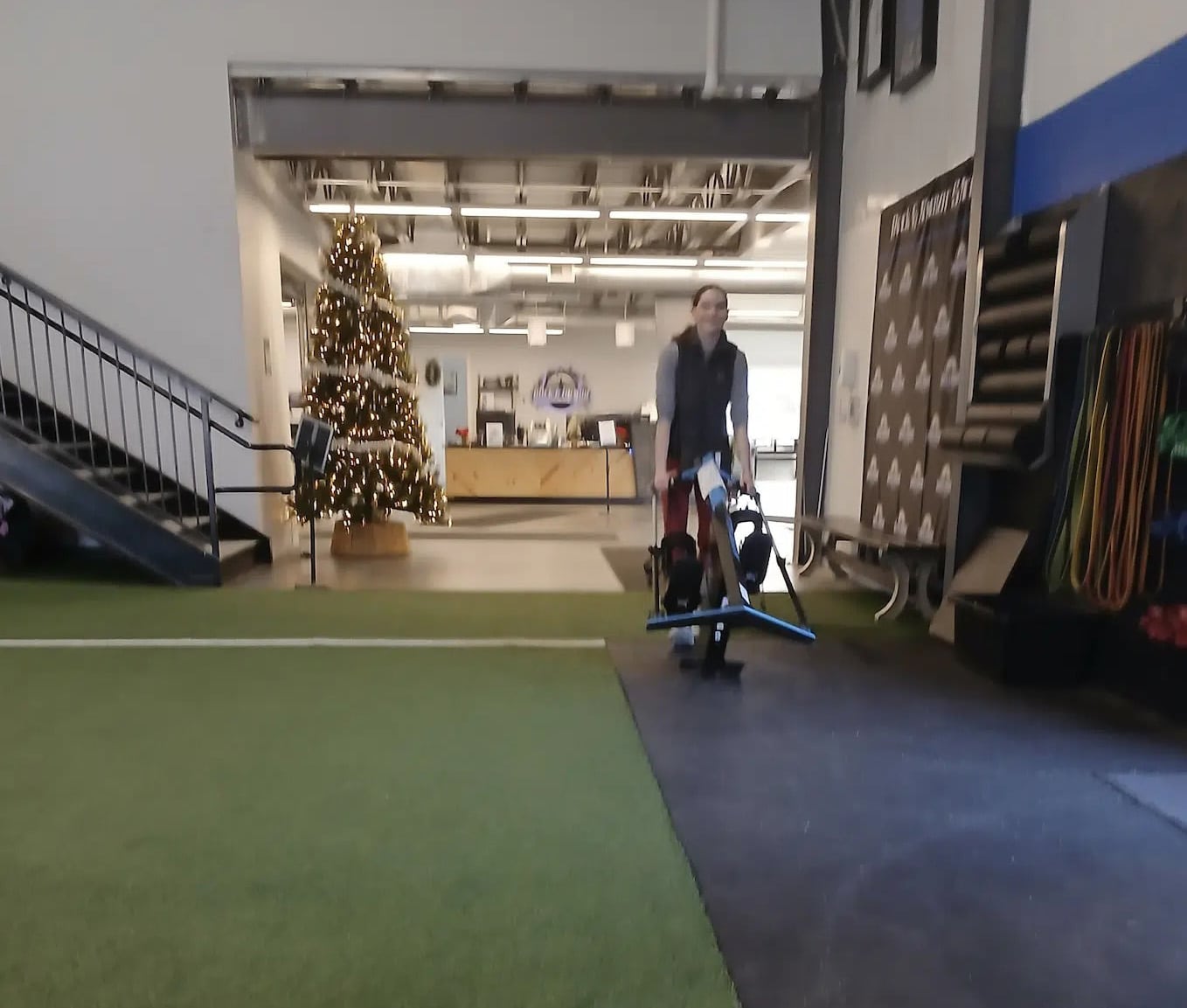
An FES bike is an exercise cycle for people whose leg muscles can’t do the work of pedaling on their own. Small electrodes over the leg muscles send pulses of electrical current, the muscles contract, and the legs turn the pedals together with a motor. The rider’s legs rest in cradles, and a touchscreen shows the session time, stimulation level, Calories, power in Watts, and distance. FES cycling gives people with leg paralysis or weakness a way to do aerobic exercise with their leg muscles working. The FES page on our site covers the technology in more detail.
In the United States an FES bike is regulated as an external functional neuromuscular stimulator (21 CFR 882.5810), which means a prescription is required and the manufacturer needs FDA clearance before selling it.
How does an FES bike work?
An FES bike works by timing electrical stimulation to the pedals while a motor holds the cranks at a steady cadence. Three parts do this on the MyoCycle:
- Electrodes over the quadriceps, hamstrings, and gluteal muscles of both legs deliver the stimulation, and Home Plus and Pro Plus models add channels for the trunk and lower leg
- An electric motor holds the cranks at a steady 35 revolutions per minute
- Software times the stimulation to the pedal position, so each muscle group fires as the pedals turn, and it detects spasms automatically

The motor pedals for the rider up to 35 rpm if the rider can’t pedal that fast. If the rider pushes faster, the motor resists, pushing back as hard as the rider pushes while keeping the cadence smooth. The stimulation runs on top of that, so the work is shared between the motor and the muscles. At the start of each session the MyoCycle measures the work of moving the rider’s legs and the cranks and subtracts it, so the power plot shows the rider’s own effort, down to 1 W. Home riders also get a weekly progress report by email.

What does FES cycling do for the body?
FES cycling can improve muscle health, cardiorespiratory fitness, and power in people with spinal cord injury, and the research is largest for that group. A 2021 systematic review of 92 studies with 999 adults with spinal cord injury found improvements in lower-body muscle health (graded high certainty) and, in nearly all of 35 lower-level studies, improvements in power output and aerobic fitness (graded low certainty) (van der Scheer et al., Journal of NeuroEngineering and Rehabilitation). A 2025 meta-analysis of 52 studies found moderate-to-high certainty improvements in cardiorespiratory fitness, leg and total-body lean mass, and power (Frazão et al., Archives of Physical Medicine and Rehabilitation).
The MyoCycle is cleared for general rehabilitation for relaxation of muscle spasms, prevention or retardation of disuse atrophy, increasing local blood circulation, maintaining or increasing range of motion, and muscle re-education. To summarize, it eases spasms, slows the muscle loss that comes from not moving, gets blood moving in the legs, helps keep joints moving, and retrains muscles to fire. People with spasms, muscle loss, or stiff joints often move less easily, so each of these cleared uses supports functional movement.
Who rides an FES bike?
The MyoCycle is a bike for wheelchair users and others with paralysis or muscle weakness from spinal cord injury, multiple sclerosis, and stroke. They ride it at home, and rehabilitation hospitals, outpatient neurorehabilitation clinics, and VA facilities use it with patients. At Craig Hospital, for example, FES cycling is part of the inpatient program, with 72 FES cycling slots every week (see our Craig Hospital partner spotlight). Activity-based therapy centers for people with paralysis, such as NextStep Orlando, also commonly use FES bikes. Stories from riders are collected on our stories page.
Most MyoCycle riders train at home. About 94% of MyoCycles go to people riding at home, and the rest go to clinics and other facilities. Among riders with clear diagnoses, about three in four have a spinal cord injury and about one in seven has multiple sclerosis. The rest include stroke, brain injury, cerebral palsy, transverse myelitis, and other conditions.
Who should not use an FES bike?
FES bikes should not be used by people who have a cardiac pacemaker, implanted defibrillator, or other implanted electronic device, unhealed bone fractures in the legs, severe contractures or extremely limited joint range of motion, or extreme osteoporosis or osteogenesis imperfecta. Each FES bike’s labeling may list additional conditions, so check it for whichever bike you are considering.
Some conditions call for caution rather than exclusion. Patients with heart disease or epilepsy should follow the precautions their physicians recommend, and the safety of stimulation during pregnancy has not been established. A spinal cord injury at or above T6 carries a risk of autonomic dysreflexia, a sudden spike in blood pressure that stimulation can trigger. Emptying the bowels and bladder before a session lowers the risk. Skin irritation under the electrodes can happen, and riders with neurological impairments can run warm, so most FES bikes are for indoor use. For children or people with cognitive impairments, the labeling calls for appropriate supervision, for example by an adult or therapist, and says not to leave a patient unattended during a session unless the patient can use the MyoCycle without assistance. Our team will help you work out whether the MyoCycle suits you.
Do you need a prescription for an FES bike?
Yes. In the United States, FES bikes are prescription-only medical devices, and their labeling says only patients with a prescription should use them. A physician signs the prescription, and our team prepares the paperwork the physician needs. The labeling also directs use under the continued supervision of a licensed healthcare practitioner, and electrode placement and stimulation settings should follow the guidance of the prescribing practitioner.
Is an FES bike for home or for the clinic?
Both. MyoCycle Home and Home Plus are built for one person to use at home, with automatic stimulation control. Home Plus adds 4 more stimulation channels (10 in all) and a Bluetooth heart rate display, and it also offers a walking gait mode. MyoCycle Pro and Pro Plus are for clinics, and they add manual stimulation control, MyoPortal access, unlimited patient profiles, and clinical training. The home models and the clinic models each have a page with the details. A clinic can also refer a patient to a home bike through our referral page.

How much does an FES bike cost, and how do people pay?
People pay through insurance, grants, state programs, vocational rehabilitation, and personal funds. Our funding team has helped secure more than $600,000 in funding, including insurance coverage, for people buying MyoCycle Home and Home Plus! Our guide, how to pay for an FES bike, covers each route. FES cycling therapy systems as a category run from less than $10,000 to over $30,000 for full-featured systems designed for a rehab center, MYOLYN gives MyoCycle pricing when you request information, and Pro and Pro Plus are quoted for each clinic.
Which FES bikes are available?
The MyoCycle is designed and manufactured by MYOLYN in Gainesville, Florida, and it is also available in the United States through Lifeward, a distributor. The other FES bike a buyer is likely to meet is the RT300 from Restorative Therapies. Our MyoCycle and RT300 comparison compares the two side by side, and our buyer’s guide to comparing FES bikes lists what to check on any of them.
How do you get started with an FES bike?
Start with a conversation with your physician or therapist about whether FES cycling fits. Then request more information, and our team will send information about the MyoCycle and answer your questions. We match you with the right person on our team, work out funding with you, and prepare the prescription request for your physician. If you are a clinician, you can refer a patient directly.
The MyoCycle is a prescription-only medical device.