To compare FES bikes, check six things on each one: its FDA status, what the motor and stimulation do, who it is labeled for, whether it is built for home or clinic, what the evidence says, and what the full cost and support look like. MYOLYN makes the MyoCycle, and each competitor fact below links to its source.
What FES bikes can you choose from?
Three FES bikes come up most often in the United States:
- MyoCycle, made by MYOLYN in the United States, in four models (Home, Home Plus, Pro, and Pro Plus), for home and clinic use. It is cleared under 510(k) K213925 (2022).
- RT300, made by Restorative Therapies (RTI). RTI’s RT300 page describes up to 12 stimulation channels and leg, arm, and core configurations, for use in the clinic and at home. Its most recent RT300 clearance in FDA’s database is K162470 (2017).
- RehaMove, from Hasomed in Germany. Its most recent RehaMove clearance in FDA’s database is K112844 (2011). RehaMove is still available to buy, but it is very uncommon in the United States, and Hasomed now lists it among its legacy products.

All three are prescription-only, FDA Class II stationary systems for therapeutic exercise. BerkelBike, a Dutch outdoor recumbent cycle with an optional FES stimulator, is not sold in the United States and has no FDA clearance, so it is not an option for a US buyer.
Is an FES bike cleared by the FDA?
Yes. The FES bikes sold in the United States are cleared by FDA through the 510(k) process, which means FDA found each one substantially equivalent to a device already on the market. A clearance does not mean one bike outperforms another. You can check any bike by asking the seller for its 510(k) number and searching it in FDA’s database. The most recent clearance for each is:
Each 510(k) summary also lists what the bike is indicated for. The MyoCycle (K213925 summary) and the RT300 (K162470 summary) are indicated for general rehabilitation for relaxation of muscle spasms, prevention or retardation of disuse atrophy, increasing local blood circulation, maintaining or increasing range of motion, and muscle re-education. The RehaMove (K112844 summary) is not intended for muscle re-education, since its indications list the first four only.
What were the first FES bikes?
The first FES bikes were the REGYS and ERGYS series, stationary cycles that grew out of FES research at Wright State University in Dayton, Ohio, in the early 1980s (Christopher & Dana Reeve Foundation). FDA cleared the first of them in April 1984 under 510(k) K841112, listed as the TTI Rehabilitation Gym System from Therapeutic Technologies, Inc. The ERGYS line was later made by Therapeutic Alliances. Many of the early studies of FES cycling for people with spinal cord injury used these machines, and today’s FES bikes build on that research.
How do the motor and stimulation differ?
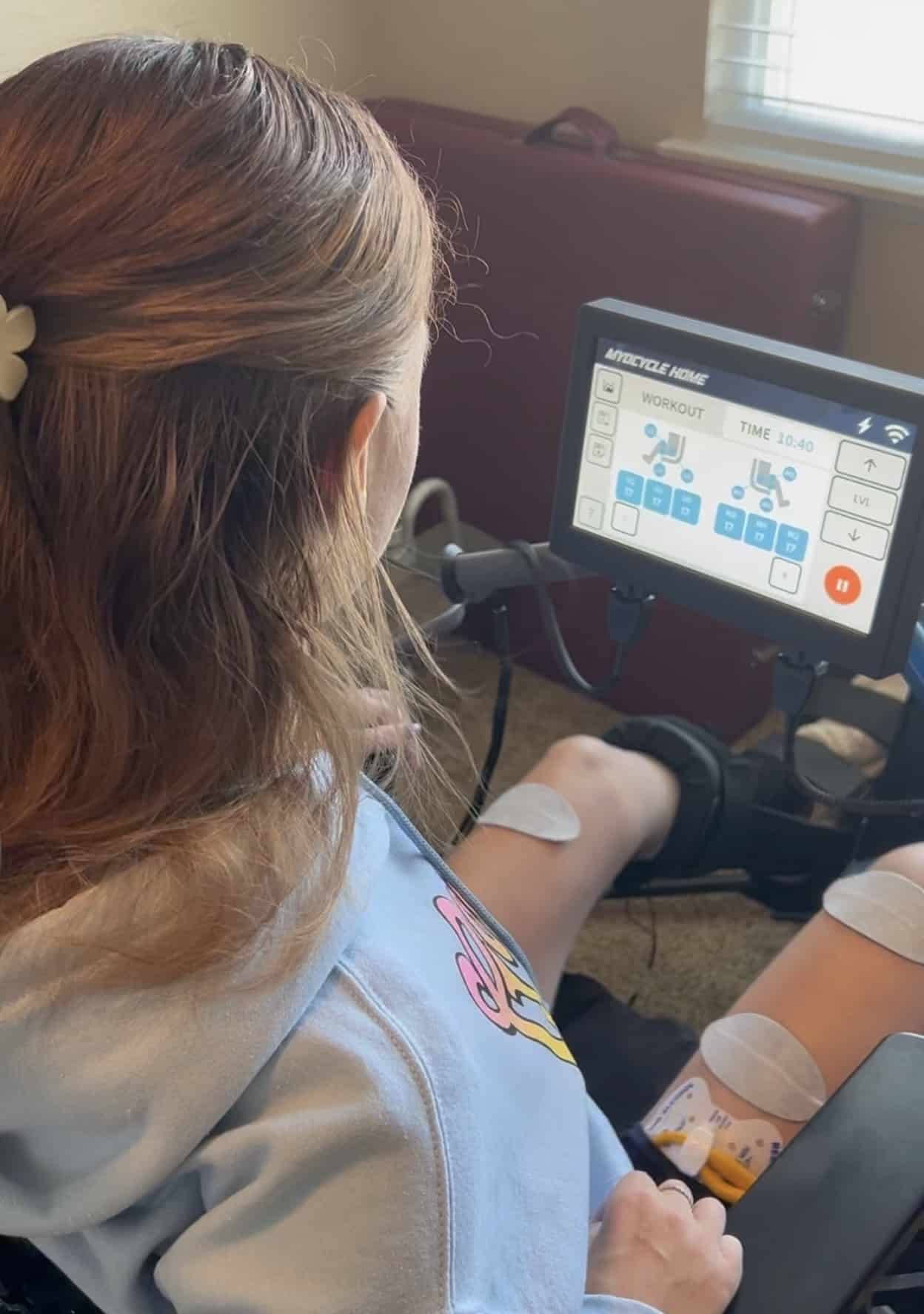
The main difference is cadence. The MyoCycle holds the cranks at a fixed 35 ± 5 rpm, and RTI lists an adjustable 15 to 55 RPM for the RT300. The RehaMove pairs with a MOTOmed motorized trainer (K112844 summary), which has a similar range, 1 to 60 rpm on the MOTOmed viva 2. On the MyoCycle a motor pedals for the rider if the rider can’t keep up, and it resists if the rider pushes faster, and the stimulation is timed to the pedal position. It has 6 stimulation channels (Home and Pro) or 10 (Home Plus and Pro Plus). The MyoCycle is the only FES bike with automatic stimulation controls that make it easy for the user to adjust stimulation intensity each session. The RT300’s automatic stimulation control works differently: it can increase the stimulation for the user automatically, according to a program preset by a clinician (NICE MIB169). Otherwise, the RT300 and RehaMove use manual stimulation controls, which require expert guidance and clinician oversight (RTI patient assessment, RehaMove2 catalogue), and home users have the stimulation controls locked. RTI’s comparison post describes the RT300 with up to 12 channels, adjustable cycling speed from 15 to 55 RPM, and arm cycling configurations. Ask each seller how cadence is set and who adjusts it.

Who is each bike labeled for?
The MyoCycle labeling covers patients ages 12 and older, under 120 kg (265 lb), and between 145 and 193 cm (4’9″ and 6’4″) tall, and it covers the legs and trunk only. RTI’s page says the RT300 is for ages 4 and up, with a pediatric model for children between four and twelve and a configuration that exercises the arms. Very small children, or riders who want arm stimulation, will find the RT300 fits that need and the MyoCycle does not. For arm stimulation, also take a look at our MyoSpark.
Is it built for home or for the clinic?
MyoCycle Home and Home Plus are built specifically to make FES cycling safe, effective, and easy to do at home, and MyoCycle Pro and Pro Plus are built for rigorous clinical demands. The RT300 and RehaMove do not have separate models for homes and clinics. RTI’s RT300 brochure says its design is intended for home or clinic use, and Hasomed’s RehaMove2 catalogue offers one system for clinic treatment and home use. Whichever you choose, the seller should be able to say who sets it up, who trains the rider, and who to call when something breaks. MyoCycle Home comes with a 60-day satisfaction guarantee and a warranty that covers the frame for the life of the device and other parts for three years from delivery, in the United States. The return policy and warranty are worth having in writing from any seller.
What does the evidence say?
The strongest research supports FES cycling as a category, and it is not specific to one bike. A 2021 systematic review of 92 studies with 999 adults with spinal cord injury found improvements in lower-body muscle health (van der Scheer et al., Journal of NeuroEngineering and Rehabilitation). A 2025 meta-analysis of 52 studies found improvements in cardiorespiratory fitness, lean mass, and power (Frazão et al., Archives of Physical Medicine and Rehabilitation). Those reviews pool studies across devices.
Head-to-head data comparing individual FES bikes are small in general, and a University of Miami study is the only one published. That study of four men with spinal cord injury (poster) found higher gross mechanical efficiency on the MyoCycle (23.3%, against 16.7% for the RT300). It had four participants, so it is a preliminary finding. Our MyoCycle and RT300 comparison covers the study and the other differences.
What does an FES bike cost?
Across the category, FES cycling therapy systems run from less than $10,000 to over $30,000 for full-featured systems designed for a rehab center. When you compare any two bikes, ask each seller for the total, including shipping, setup, electrodes and other supplies you will buy again, training, and warranty terms. The MyoCycle is by far the most affordable option. Insurance, grants, and other programs can pay part or all of the cost, and our guide, how to pay for an FES bike, lists the routes. MYOLYN gives MyoCycle pricing when you request information, and Pro and Pro Plus are quoted for each clinic.
What should you ask every seller?
- What are the indications and contraindications?
- What does the device cost, along with installation and upkeep, such as replacement stimulation cables and electrodes?
- Can you control the stimulation settings on your own?
- How can you tell how much of the work you are doing and how much the motor is doing?
- Do you have social events for riders, such as group rides?

What if the MyoCycle is on your list?
If the MyoCycle is on your list, request more information and our team will answer your questions about fit and funding! Our guide to what an FES bike is covers the basics for anyone starting the search.
The MyoCycle is a prescription-only medical device.
Photo from the MyoCycle Story Project.